Flooring, June 29, 2026
Does Floor Beading Still Work in Modern Homes?
If you’re planning to install a new wood floor, you’ve probably come across the debate around floor beading.
Many homeowners immediately say they want to avoid beading altogether. While a beading-free finish can certainly look fantastic, what many people don’t realise is that achieving this look often requires existing skirting boards to be removed and, in some cases, replaced entirely.
Before deciding whether floor beading is right for your home, it’s important to understand what’s involved in creating a beading-free finish and the additional costs that can come with it.
The reality is that floor beading remains a practical, attractive, and cost-effective solution for many modern homes, particularly when compared to the expense and disruption of replacing skirting boards.
What Is Floor Beading?
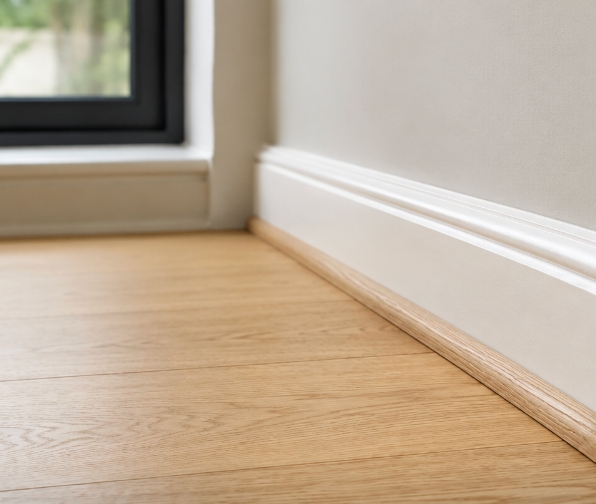
Floor beading, often referred to as scotia or quadrant beading, is a decorative trim fitted around the perimeter of a room where the flooring meets the skirting board.
Its primary purpose is to cover expansion gaps that are required when installing most types of flooring, including:
- Engineered wood flooring
- Solid wood flooring
- Real wood flooring
Wood floors naturally expand and contract due to changes in temperature and humidity. To accommodate this movement, installers typically leave expansion gaps of around 8mm to 12mm around the edge of the room.
Without these gaps, flooring can buckle, lift, or suffer from warping over time.
Beading neatly covers these expansion gaps while allowing the floor to continue moving naturally.
Why Do Floors Need Expansion Gaps?
Whether you’re installing solid wood or engineered wood, expansion gaps are an essential part of a successful installation.
Floating floors naturally expand and contract throughout the year. These small movements are completely normal and help maintain the floor’s long-term durability.
The expansion gap allows the flooring to move without putting pressure on walls, door frames, or other fixed objects.
Beading is specifically designed to cover these gaps while providing a neat and professional finish.
Why Do Some Homeowners Want to Avoid Beading?
In recent years, many interior design trends have favoured a seamless appearance where the flooring appears to run directly underneath the skirting boards.
This can create:
- A sleek finish
- Clean lines
- A minimalist appearance
- Strong aesthetic appeal
- A contemporary look
There’s no doubt that this can look fantastic when executed properly.
However, many homeowners are surprised when they discover what is required to achieve this finish.
The Real Cost of Avoiding Beading
One of the biggest misconceptions in flooring is that removing beading automatically creates a better finish at little extra cost.
In reality, avoiding beading usually means removing the existing skirting boards before the flooring installation begins.
This often involves:
- Carefully removing skirting boards
- Repairing damaged plaster
- Replacing damaged boards
- Purchasing new skirting
- Re-fitting skirting after installation
- Filling and sanding joints
- Repainting walls and woodwork
- Potentially replacing sections of architrave
In older properties, skirting boards are frequently fixed using a combination of nails, adhesive, and multiple layers of paint. As a result, removal can cause cracking, splitting, or damage to both the skirting and surrounding walls.
Even if the boards are successfully removed, some degree of decorating work is often required afterwards.
For many homeowners, these additional costs come as a surprise.
Replacing Skirting Boards Can Significantly Increase Project Costs
If you’re installing new flooring throughout multiple rooms or an entire property, the costs associated with replacing skirting boards can quickly add up.
Additional expenses may include:
- New skirting boards
- Carpenter labour
- Decorating materials
- Wall repairs
- Caulking and filling
- Painting and finishing
Depending on the size of the property and the condition of the existing skirting, these costs can easily run into hundreds or even thousands of pounds.
When comparing quotations, it’s important to consider not only the flooring itself but also the associated work required to achieve a beading-free finish.
Beading vs Skirting Boards: A Practical Comparison
| Consideration | Floor Beading | Remove & Replace Skirting |
| Covers expansion gaps | ✓ | ✓ |
| Additional carpentry work | Minimal | Often required |
| Wall repairs required | Rare | Common |
| Decorating work | Usually none | Often required |
| Installation time | Faster | Longer |
| Project disruption | Lower | Higher |
| Overall project cost | Lower | Higher |
For many homeowners, the decision comes down to balancing appearance, budget, and practicality.
Why Beading Remains a Popular Choice
Despite changing design trends, floor beading continues to be widely used because it offers several practical benefits.
Cost-Effective
Beading is generally far more affordable than replacing skirting boards.
Faster Installation
Installation typically involves measuring, cutting, and gluing or pinning the beading into place.
A standard room can often be completed within one to two hours.
Less Disruption
Because the existing skirting remains in place, there’s usually no need for wall repairs or redecorating.
Protection
Beading can help protect exposed floor edges from vacuum cleaners, foot traffic, and general wear.
Professional Finish
When professionally fitted and colour-matched to the flooring, beading can create a neat, polished appearance that complements both traditional and modern interiors.
What Materials Are Available?
Modern beading is available in a wide range of materials and finishes.
Common options include:
- MDF beading
- Solid wood beading
- Timber beading
- PVC beading
- Primed white beading
Many flooring manufacturers produce matching trims designed to complement specific flooring ranges.
Beading is available in various shades to match flooring, while primed white options can be painted to match existing skirting boards.
When chosen carefully, beading can blend seamlessly into the overall design of a room.
When Does Beading Work Best?
Although some homeowners prefer the appearance of flooring installed underneath skirting boards, there are many situations where beading remains the most practical option.
Older Properties
Traditional homes often feature:
- Uneven walls
- Heritage skirting boards
- Decorative mouldings
- Original woodwork
Removing these features can increase costs and risk unnecessary damage.
Renovation Projects
When renovating a room, many homeowners prefer to avoid the additional expense of redecorating walls and replacing woodwork.
Existing Skirting in Good Condition
If the skirting boards are already in excellent condition, replacing them may offer little practical benefit.
Budget-Conscious Projects
For homeowners looking to keep project costs under control, beading often provides the best balance between appearance and value.
Does Beading Look Outdated?
This is one of the most common concerns homeowners have.
The truth is that poorly installed beading or badly matched colours can detract from the appearance of a floor.
However, modern beading products are far more refined than many people realise.
Slim profiles, carefully matched finishes, and professional installation techniques can produce a subtle and attractive result that many people barely notice once the room is furnished.
While a beading-free finish may offer a slightly more seamless aesthetic, the difference is often far less dramatic than homeowners expect, particularly when compared to the additional costs involved.
So, does floor beading still work in modern homes?
Absolutely.
While many homeowners initially prefer the idea of a beading-free finish, they often underestimate the additional work required to achieve it. Avoiding beading typically means removing skirting boards and, in many cases, repairing, replacing, and redecorating them afterwards.
For some projects, that additional investment may be worthwhile.
However, for many homeowners, the extra labour, materials, decorating costs, and disruption simply don’t justify the difference in appearance.
Modern floor beading remains a practical, affordable, and professional solution for covering expansion gaps while avoiding the significant costs associated with replacing skirting boards.
When colour-matched and professionally fitted, it continues to provide a neat finish that works well in both traditional and modern homes.